
Human Capacity
You are invited to explore with me the new version of our Fluency in Care proposal

Peniche, 7 December 2025
We (Komuhn.org) are expanding a few concepts which we believe need new interpretations — as Pedro shared when he published1 the latest developments of the new iteration of Fluency in Care.
It is also an invitation for us to share a cup of tea and talk. I want to explore this proposal further in real-time conversations, with you. We can talk in portuguese, english, in a mix of both, or french, play with spanish and italian, or better even, in a mix of them all. To discover what’s lost and found in translation. Because I want to hear from you and find these notions in your experience. With you, I want to reveal new words, create new expressions. A common language of care.
Human Capacity
Because we still dare to imagine more livable futures — to talk more and be able to express and deepen our understanding of care as a collective commitment, it is essential that we explore the meaning of Human Capacity.
In the following images, you’ll find how we’re beginning to describe, and map, Human Capacity across multiple dimensions. We’d love to hear your thoughts and reflections. We’ve also created a shared document (link) where you can read a more detailed text version and, if you prefer, add suggestions directly in context.
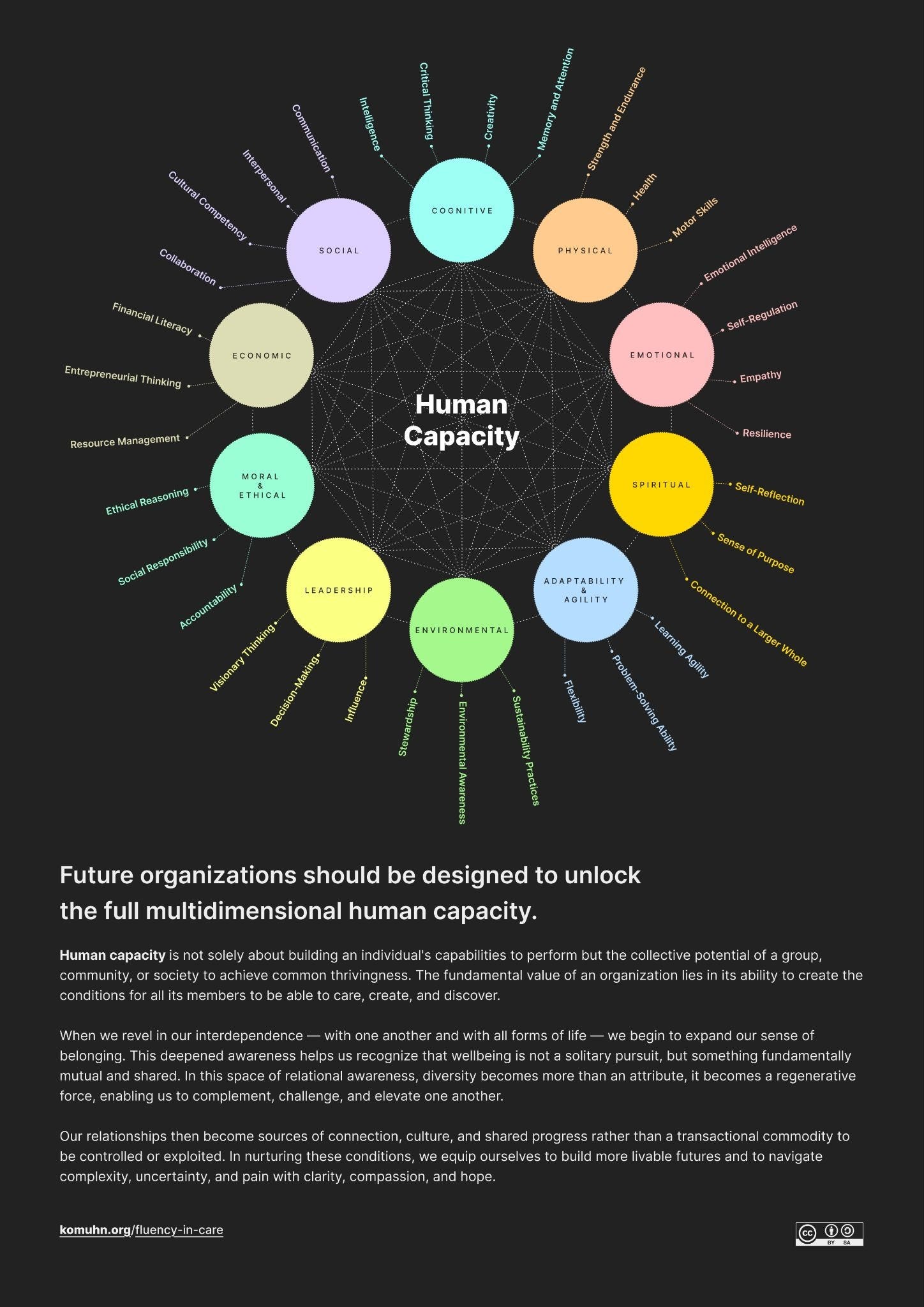
With this work, we’re looking to align the perceptions implied in the words we’re using and to evolve the language that’s emerging from our new realizations. Here are some examples of what’s guiding our thinking:
- The point of view is collective: We’re conditioned to interpret human capacity as individual ability. But we’re exploring how capacities emerge and amplify at the group level. For example, creativity isn’t just a trait of a singular mind, it’s something a group can cultivate, distribute, and expand.
- The term as an enabler of perspective: Choosing to use the word capacity instead of using ‘time’ or ‘money’ can unfold new conversations. By considering the superset, we acknowledge that there’s more implicit meaning, and that we need to assess all its parts. For instance, when someone states that there’s “no time” left to do something, we can instead talk about the reasons for that perceived shortage and bring in other capacities that can make up for it.
- Systemic awareness: By expanding the concept of human capacity into a set of shared capabilities, we start seeing how they connect and affect each other. This allows us to identify where the group is sensing imbalances, and propose ways to allow the oddity, embracing the value of the group’s uniqueness, or finding ways to restore balance.
- Inspire new shared practices: Through this exploration, we’re uncovering new ways to benefit from a common language. From designing new group routines to challenging social patterns, we’re curiously looking for better ways to relate, organize and create together. One manifested usability is capacity matching, to measure the potential opportunities within a group: for example, if we signal that we have capacity:financial-literacy and capacity:environmental-awareness, what might that allow us to do? Do you have more ideas? Share them with us!
We’re currently being very critical of the language we use and the associations we make, and we’re especially interested in input towards changing terminology, adding or removing elements, and questioning our categorizations and relationships. We’d also love to hear about any work you know of that explores similar directions.
(Pedro’s invitation in M/ANY: https://substack.com/home/post/p-169938737)
After this introduction, it seems that things have become serious, and I recognize that this may complicate the lightheartedness expected of an invitation to have a cup of tea. The thing is, I sometimes think like this: the complication already existed before, and however disguised it may have been, this still seems to me to be the best way to approach it, in my relationship with you, with the sweetness of a shared moment.
So, will you come and meet my sofa, or shall I come and try out yours?
I’ll bake the cake, you can make the tea.
It can also be a call, with or without video.
It can just be us, or we can invite someone else. Children are always welcome and aren’t part of this calculation.
I prefer to let our time happen, but I think we need at least 40 minutes.
I’m going to try out different formats, some more conversational, others more interview-like, me to you and you to me, then it depends on what you’ve already read about the proposal or what’s going on in that restless mind of yours.
What is certain is that we will take advantage of the opportunity to catch up, flirt, and vent. It’s all part of the same language.
When is our day? I am available every day of the week and prefer afternoons, but I can also do mornings if necessary. To schedule: send me a message (here as a comment, to my Substack profile, via Facebook or Instagram, to my phone number or Whatsapp, if you have it) or email me (andrea@komuhn.org).
See you soon!
With love,
Andréa

[Lê esta publicação em português]
Um convite para explorares comigo a nova versão da nossa proposta Fluência no Cuidado. Com um chá e um bolinho a aconchegar. Qual é o nosso dia?
Capacidade Humana:
https://open.substack.com/pub/andreaadonispx/p/capacidade-humana?utm_campaign=post-expanded-share&utm_medium=post%20viewer